
From Executive Chef to Locked-In Syndrome:
How Occupational Therapy Helped Jake Haendel Reclaim His Life
Ten months in a coma-like state with locked-in syndrome left Jake with a death sentence. This is the story of his survival, perseverance, and the healthcare heroes—especially his occupational therapy practitioners—who helped him learn to move, speak, and thrive again.
Who Is Jake Haendel and What Is Locked-In Syndrome?
“I’m Jake Haendel and I was diagnosed with a brain disease called Toxic Acute Progressive Stage 4 Leukoencephalopathy. It took me from a high functioning and able-bodied individual – I was an executive chef in Boston! – to a rare and terminal condition, in just a few months.
In the hospital, a team of doctors told me I would decline rapidly and most likely die within six months. Within one month I lost most of my abilities and shortly thereafter, I could no longer eat or drink. The illness left me unable to move or speak and I was in a coma-like state for 10 months.
Doctors thought I was brain dead, but in reality, I was conscious and could hear everything. I had locked-in syndrome (LIS), a condition in which a patient is aware but cannot move or communicate verbally due to complete paralysis of nearly all voluntary muscles in their body except for vertical eye movements and blinking.
I am the only documented case of recovery from stage four of this brain disease.
I survived something I shouldn’t have, and now I’m making the most of it.”
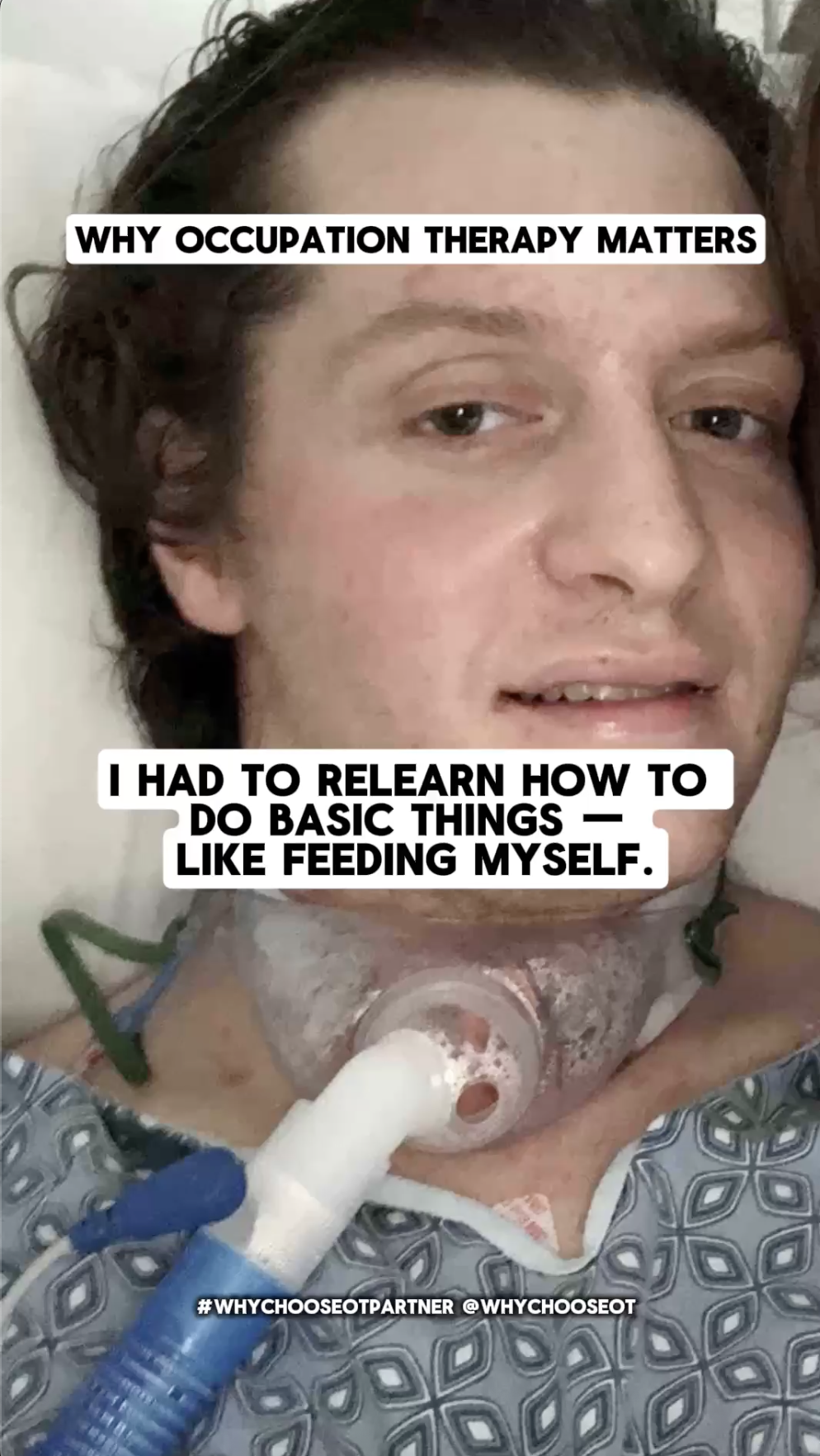

How Occupational Therapy Helped Jake
Coming back to life hasn’t been easy—and it wouldn’t have been possible without my incredible Occupational Therapy (OT), Physical Therapy (PT), and Speech Language Pathology (SLP) teams. Therapy often overlapped, but OT was central in helping me rebuild my independence.
I had to retrain my brain to communicate with my body and relearn how to do basic things like blink, feed myself, walk, and take care of myself.
Occupational therapy practitioners (OTPs) didn’t just help me move, they helped me get back to my life.
As a former executive chef, my arms and hands were everything. My OTPs created customized interventions—to restore grip strength and dexterity—that were critical for basics like feeding myself, but also for getting me closer to being able to hold a knife, a ladle, or even a golf club again.
My OTPs didn’t just treat me – they listened to me. They focused on my goals, not just on my condition. And they made sure that every one of my goals was customized to my body and my life.
OT isn’t just a kind of rehab. It helped me reclaim my life and my independence.
Learn More about OT
Occupational therapy (OT) is a healthcare profession that helps people do the everyday activities that matter most to them—like getting dressed, eating, playing sports, learning, or even using technology. OT professionals work with people of all ages to overcome challenges, regain independence, and participate fully in life!
OT is a life-changing career for practitioners and their patients. If you are passionate, like helping others, being creative, and solving problems, OT might be the career for you. YOU could be the reason someone – like Jake – moves forward and gets their life back.



Follow Us
More About Jake Haendel
Follow Jake:
Listen to Jake’s complete, tell-all story:

